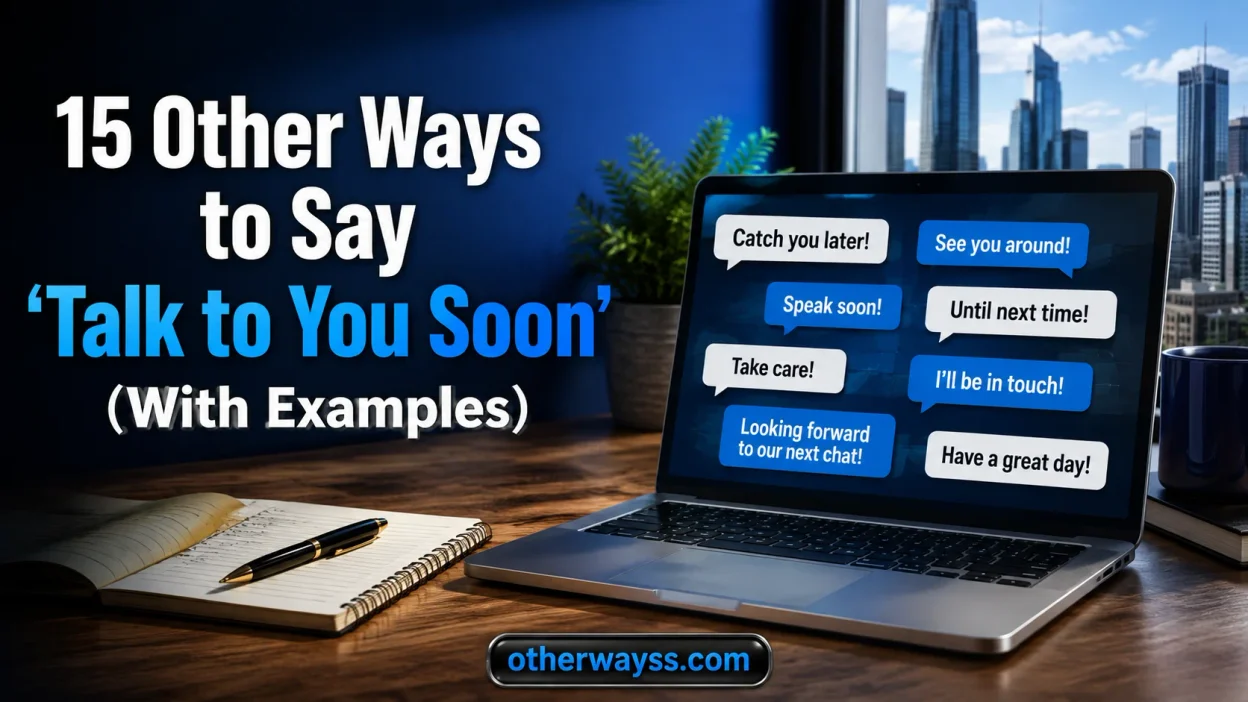
Talk to you soon is a familiar way to end a conversation while suggesting future contact. However, different communication settings may call for warmer, more professional wording or more casual wording. Choosing natural alternatives can make texts, emails, calls, and everyday messages feel more thoughtful.
For example, talk to you then, talk soon, or speak to you shortly can suit different contexts and relationships. Meanwhile, speak to you soon professionally may need a clearer sign-off in professional emails. This guide explores natural alternative expressions, their meanings, and realistic examples to help you choose the right words.
Synonyms For “Talk to You Soon”
- Speak to you soon
- Talk soon
- Catch up with you soon
- Chat with you soon
- I’ll be in touch soon
- I’ll talk to you later
- Looking forward to talking with you
- Until we talk again
- Hope to hear from you soon
- I’ll get back to you soon
- We’ll talk again soon
- Keep in touch
- Take care until we talk again
- I look forward to speaking with you soon
- Until next time
What Does “Talk to You Soon” Mean?
“Talk to you soon” means that you expect to communicate with someone again in the near future. It is commonly used as a friendly closing at the end of a conversation, text message, phone call, email, or online chat.
The word “soon” is intentionally flexible. It does not necessarily mean later today or tomorrow. The exact timing depends on the context and the relationship. If you tell a friend, “Talk to you soon,” you might mean that you expect to text or call them within a few days. In a workplace message, it could simply mean that another conversation is likely to happen shortly.
The phrase also carries a small amount of warmth and expectation. Rather than ending with a neutral “goodbye,” you are signaling that the current conversation is not the end of your communication.
For example:
“Thanks for catching up with me. Talk to you soon!”
This sounds friendly and suggests that you expect another conversation.
It can also be shortened to “Talk soon,” which is especially common in casual texting and messaging.
Importantly, “talk to you soon” does not promise a specific date or time. If you have already arranged another conversation, a more precise expression such as “I’ll call you tomorrow” may be clearer.
When to Use “Talk to You Soon”
“Talk to you soon” is most natural when there is an ongoing relationship or an expectation of future communication.
With friends and family, it sounds relaxed and friendly:
“Thanks for calling! Talk to you soon.”
With a partner, it can be affectionate without being overly romantic:
“Have a good night. Talk to you soon ❤️”
In text messages, it is a natural way to close a conversation without sounding final or distant.
It can also work in the workplace, particularly when speaking with a colleague you know reasonably well:
“Thanks for your help today. Talk to you soon.”
In a more formal email, however, a phrase such as “I look forward to speaking with you soon” may sound more polished.
The phrase is less suitable when you have no real expectation of speaking again soon. If you are ending communication permanently or are unsure whether you will reconnect, “talk to you soon” could create the wrong impression.
Is It Professional or Polite to Say “Talk to You Soon”?
Yes. “Talk to you soon” is polite, but its level of formality depends heavily on context.
It is generally friendly, informal, and conversational rather than highly formal. That makes it excellent for colleagues you know, clients with whom you have an established relationship, and everyday professional conversations where a relaxed tone is appropriate.
For example:
“Thanks for walking me through the changes. Talk to you soon.”
This can sound perfectly professional in a friendly workplace.
However, a formal business email to someone you have never met may benefit from:
“I look forward to speaking with you soon.”
That version sounds more respectful and polished without becoming stiff.
The key distinction is that “talk to you soon” is not inherently unprofessional. It simply has a casual conversational tone. Your relationship, industry, communication channel, and purpose should determine whether it is the right choice.
1. Speak to You Soon
“Speak to you soon” is one of the closest natural alternatives to “talk to you soon.” The meaning is almost identical, but it can sound slightly more polished or deliberate, particularly in professional communication.
It works well when you already expect another conversation but do not need to specify exactly when it will happen. You can use it in a phone conversation, email, text, or workplace message.
The phrase is especially useful when “talk” feels a little too casual for the situation. For example, after arranging a follow-up call with a colleague, “Speak to you soon” provides a friendly closing without sounding overly informal.
It should not be treated as dramatically more formal than “talk to you soon,” though. It remains a conversational closing.
Scenario
Scenario: You have just finished a video call with a colleague and agreed to continue discussing a project later in the week.
Examples
- “Thanks for your time today. Speak to you soon.”
- “I’ll send over the revised document this afternoon. Speak to you soon.”
- “Great catching up with you. Speak to you soon!”
- “Thanks for clarifying everything. Speak to you soon.”
- “I’ll let you know once I hear back from the team. Speak to you soon.”
Tone
Friendly, polite, conversational, and slightly polished.
Explanation
This is a particularly close replacement because it preserves the original phrase’s core meaning: you expect another conversation in the near future. The difference is mainly stylistic. “Speak to you soon” can feel a little more composed, while “talk to you soon” often sounds more casual and familiar.
Best Use
Best Use: Workplace conversations, phone calls, emails with familiar contacts, and friendly professional communication.
2. Talk Soon
“Talk soon” is the shorter, more casual version of “talk to you soon.” It removes “to you” without losing the intended meaning.
This alternative is especially common in texts, messaging apps, social media conversations, and casual exchanges. Because it is brief, it feels effortless and natural rather than carefully composed.
It is a good choice when you have already established a friendly relationship with the other person. You do not need to spell out the entire phrase because the meaning is obvious from context.
“Talk soon” can also feel slightly more relaxed than “talk to you soon.” It is ideal when you want to end a conversation warmly without making the closing sound formal.
Scenario
Scenario: You have been texting a friend about weekend plans and need to leave the conversation because you have to get ready for bed.
Examples
- “I’ve got to head out now. Talk soon!”
- “Thanks for the update. Talk soon.”
- “Sounds good! Talk soon 😊”
- “I’ll check the schedule and let you know. Talk soon!”
- “Have a good night. Talk soon.”
Tone
Casual, friendly, warm, and direct.
Explanation
“Talk soon” works because it communicates the same expectation of future contact with fewer words. It is less suitable for highly formal correspondence because its brevity gives it a distinctly informal feel.
It is also useful when you do not want to overthink your closing. In everyday messaging, that simplicity is part of what makes it sound natural.
Best Use
Best Use: Text messages, chats, social media, friends, family, and informal conversations.
Read More: 15 Other Ways to Say ‘Happy Thursday’ (With Examples)
3. Catch Up With You Soon
“Catch up with you soon” is useful when the next conversation will involve reconnecting and sharing updates, rather than simply exchanging a few words.
“Catch up” often suggests that some time has passed since you last had a meaningful conversation. As a result, this alternative can feel warmer and more personal than the straightforward “talk to you soon.”
It is particularly natural with friends, former coworkers, relatives, classmates, or acquaintances whom you have not spoken with recently.
It would sound less natural if you are already speaking with someone several times a day. In that situation, “talk soon” or “speak to you soon” is usually more appropriate.
Scenario
Scenario: You unexpectedly run into an old friend and agree to schedule a proper conversation because you both have a lot to catch up on.
Examples
- “It was great seeing you again. Catch up with you soon!”
- “Let’s find a day that works for both of us. Catch up with you soon.”
- “I’m glad we finally got a chance to talk. Catch up with you soon!”
- “There’s so much to tell you. Catch up with you soon.”
- “Enjoy the rest of your trip. Catch up with you soon!”
Tone
Warm, friendly, personal, and relaxed.
Explanation
The important nuance is reconnection. “Talk to you soon” simply predicts another conversation. “Catch up with you soon” suggests that the next conversation will involve sharing news, discussing what has happened, or spending time reconnecting.
Best Use
Best Use: Friends, relatives, former colleagues, old classmates, and people you have not spoken with recently.
4. Chat With You Soon
“Chat with you soon” is a relaxed alternative that works particularly well for online conversations and informal messaging.
The word “chat” makes the phrase feel lighter and less formal than “speak.” It suggests an easy, friendly exchange rather than a serious meeting or structured conversation.
This phrase is particularly appropriate when your communication normally happens through text, messaging apps, social platforms, or casual online conversations. It can also be used when speaking face-to-face, although “talk soon” may sound more natural in many spoken situations.
Avoid using it in a highly formal business setting where “speak with you soon” would better match the tone.
Scenario
Scenario: You are messaging a friend online and need to step away but expect to continue the conversation later.
Examples
- “I need to finish some work now. Chat with you soon!”
- “Thanks for sending those photos. Chat with you soon.”
- “I’ll message you when I’m free. Chat with you soon!”
- “It was fun catching up online. Chat with you soon.”
- “Have a great afternoon. Chat with you soon!”
Tone
Casual, friendly, light, and approachable.
Explanation
“Chat with you soon” is not simply a replacement in every situation. “Chat” implies an informal conversation, so it is strongest in relaxed settings. It would sound unusual in some formal correspondence, particularly when discussing serious business matters.
Its main advantage is that it creates a lighthearted and easygoing impression.
Best Use
Best Use: Texting, online chats, social media, gaming communities, and informal conversations.
5. I’ll Be in Touch Soon
“I’ll be in touch soon” shifts the emphasis slightly. Instead of specifically promising that you will “talk,” it means that you will contact the person again.
That makes it useful when the next communication could be a phone call, email, text, or another form of contact. It is also more naturally suited to professional communication than some of the casual alternatives on this list.
The phrase can sound reassuring when someone is waiting for an update. However, be careful with “soon” when you do not actually know when you will respond. If timing matters, give a specific timeframe instead.
Scenario
Scenario: A customer or colleague has asked you to confirm information, and you need some time to check the details before contacting them again.
Examples
- “I’ll review the information and be in touch soon.”
- “Thanks for sending everything over. I’ll be in touch soon.”
- “Once I have an update, I’ll be in touch.”
- “I’m checking with the team now and will be in touch soon.”
- “Thank you for your patience. I’ll be in touch soon with the next steps.”
Tone
Professional, polite, reassuring, and direct.
Explanation
Unlike “talk to you soon,” this phrase does not necessarily promise a conversation. “Be in touch” is broader and can include any future communication.
That distinction makes it valuable for workplace emails and customer communication. It also puts the responsibility for the next contact on the speaker, which can make the message feel more reassuring.
Best Use
Best Use: Professional emails, customer communication, follow-ups, and situations where you will initiate the next contact.
6. I’ll Talk to You Later
“I’ll talk to you later” is more specific than “talk to you soon.” It indicates that you expect to communicate again later, usually after the current conversation.
It is particularly natural when you know you will speak to the person again relatively soon. Friends, family members, partners, and coworkers may all use it in casual conversation.
The phrase does not necessarily mean later the same day. Context determines the timeframe. However, compared with “talk to you soon,” it can create a stronger sense that another conversation is already expected.
Scenario
Scenario: You are speaking with a friend during the afternoon, but you need to leave and expect to message them again that evening.
Examples
- “I have to get back to work. I’ll talk to you later.”
- “I’m heading out now. I’ll talk to you later.”
- “Let me finish this first, and I’ll talk to you later.”
- “I need to go help Mom. I’ll talk to you later!”
- “Have a good meeting. I’ll talk to you later.”
Tone
Casual, familiar, friendly, and direct.
Explanation
The main difference is timing. “Soon” is vague, while “later” often implies a subsequent point after the current interaction.
It is a natural choice when you already expect to reconnect and do not need a formal closing. In a formal email, however, it can sound too casual.
Best Use
Best Use: Everyday conversations, texting, friends, family, partners, and familiar coworkers.
7. Looking Forward to Talking With You
“Looking forward to talking with you” focuses less on the timing of the next conversation and more on positive anticipation.
This makes it especially useful when another conversation has already been arranged or is expected. The phrase can sound warm in personal communication and appropriately professional in workplace settings.
For example, if you have scheduled an interview, meeting, consultation, or phone call, this expression communicates enthusiasm without sounding overly emotional.
It is also useful when you want your closing to feel more thoughtful than a simple “talk soon.”
Scenario
Scenario: You have arranged a follow-up meeting with a new professional contact for next week.
Examples
- “Thanks for your time today. Looking forward to talking with you next week.”
- “I enjoyed our conversation and am looking forward to talking with you again.”
- “Thanks for sharing the details. Looking forward to talking with you soon.”
- “I’m glad we could connect. Looking forward to talking with you further.”
- “Have a great weekend. Looking forward to talking with you on Monday.”
Tone
Warm, positive, professional, and respectful.
Explanation
This is not an exact synonym because it changes the emphasis from future timing to anticipation. It works especially well when you genuinely want to communicate that you are pleased about the next conversation.
Adding a specific time can make it even clearer:
“Looking forward to talking with you tomorrow.”
That is often better than using an ambiguous “soon” when a meeting has already been scheduled.
Best Use
Best Use: Professional follow-ups, scheduled meetings, interviews, networking, and warm personal communication.
8. Until We Talk Again
“Until we talk again” has a slightly more reflective and expressive quality than “talk to you soon.”
It emphasizes the next conversation as a future point of connection rather than promising that it will happen immediately. This makes it suitable when you want a closing that feels warm but not overly casual.
It can work with friends and family, particularly after a meaningful conversation. In business communication, however, it may sound somewhat more personal or literary than necessary.
Scenario
Scenario: You have just had a meaningful conversation with a family member who lives far away and want to end your message warmly.
Examples
- “Take care of yourself until we talk again.”
- “I’m glad we had the chance to catch up. Until we talk again.”
- “Have a safe trip, and until we talk again.”
- “Wishing you all the best until we talk again.”
- “Take care, my friend. Until we talk again.”
Tone
Warm, thoughtful, gentle, and slightly expressive.
Explanation
The phrase does not necessarily mean “very soon.” That is the key distinction. While “talk to you soon” creates an expectation of relatively near contact, “until we talk again” simply acknowledges that another conversation will happen at some future point.
Best Use
Best Use: Meaningful personal conversations, family messages, close friendships, and reflective farewells.
9. Hope to Hear From You Soon
“Hope to hear from you soon” changes the direction of the expected communication. Instead of saying you will contact the other person, it expresses a hope that they will contact you.
This makes it a useful alternative only when you genuinely want or expect a response from the other person. It should not be presented as a direct synonym for “talk to you soon” because the responsibility for the next contact is different.
The phrase is common in emails and can be either professional or personal depending on the context.
Scenario
Scenario: You have sent someone information and would like them to respond when they have had a chance to review it.
Examples
- “Thanks for considering my proposal. Hope to hear from you soon.”
- “Let me know what you think. Hope to hear from you soon!”
- “I’d love to hear how the interview went. Hope to hear from you soon.”
- “Please take a look when you have time. Hope to hear from you soon.”
- “It was great connecting with you. Hope to hear from you soon.”
Tone
Polite, hopeful, friendly, and sometimes professional.
Explanation
This alternative is context-specific because it puts the next step with the other person. That makes it especially useful when you have asked a question, sent a proposal, or are waiting for a response.
In a professional email, it can be perfectly appropriate. However, if you want to avoid sounding like you are pressuring someone for a response, a softer option may be preferable.
Best Use
Best Use: Follow-up emails, professional correspondence, invitations, applications, and personal messages where you genuinely want a reply.
10. I’ll Get Back to You Soon
“I’ll get back to you soon” is a practical alternative when the current conversation involves a question, request, decision, or piece of information that you need to follow up on.
It is especially common in professional communication. The phrase tells the other person that you have not forgotten their request and intend to respond after checking something.
Unlike “talk to you soon,” it does not necessarily mean you will have a conversation. Your next contact could be an email or message.
It is therefore better understood as a follow-up expression rather than a universal farewell.
Scenario
Scenario: A coworker asks whether a meeting room is available, but you need to check the booking system before answering.
Examples
- “Let me check the schedule, and I’ll get back to you soon.”
- “I need to confirm the details first. I’ll get back to you soon.”
- “Thanks for your question. I’ll get back to you soon with an answer.”
- “I’ll speak with the manager and get back to you soon.”
- “Let me look into this and I’ll get back to you.”
Tone
Professional, responsible, polite, and reassuring.
Explanation
The key nuance is follow-up responsibility. You are promising to respond after taking some action. That makes it more specific than “talk to you soon.”
If you already know exactly when you can respond, a precise statement is even better:
“I’ll get back to you by Friday.”
That avoids creating uncertainty around the word “soon.”
Best Use
Best Use: Work emails, customer service, requests, questions, project updates, and professional follow-ups.
11. We’ll Talk Again Soon
“We’ll talk again soon” places the emphasis on the shared expectation of another conversation.
It can feel slightly warmer than “talk to you soon” because “we’ll” makes the future interaction sound mutual. Rather than simply announcing what you will do, it frames the next conversation as something both people expect.
This makes it useful for friends, family, partners, and familiar professional contacts. It can also work after an enjoyable or meaningful conversation.
Scenario
Scenario: You have just finished a long phone call with a relative and want to reassure them that you will reconnect again soon.
Examples
- “It was great talking with you. We’ll talk again soon.”
- “Take care for now. We’ll talk again soon.”
- “Good luck with everything this week. We’ll talk again soon.”
- “I’m glad we got to discuss this. We’ll talk again soon.”
- “Enjoy your vacation, and we’ll talk again soon.”
Tone
Warm, reassuring, friendly, and personal.
Explanation
The phrase is especially useful when you want to emphasize continuity. It suggests that the relationship and conversation will continue rather than ending with the current interaction.
It may sound slightly more deliberate than the very casual “talk soon,” so it can carry more emotional weight in personal communication.
Best Use
Best Use: Family conversations, close friendships, supportive messages, and familiar workplace relationships.
12. Keep in Touch
“Keep in touch” is a broader expression than “talk to you soon.” It means continue communicating with me, but it does not promise that another conversation will happen soon.
That distinction is important.
You might say “keep in touch” when someone is moving away, leaving a workplace, finishing school, or otherwise entering a new stage of life. It can also be used casually when ending a conversation with someone you do not see regularly.
Because it does not imply a specific timeframe, it is not the right choice when you already expect to speak with someone in the next few days.
Scenario
Scenario: A coworker is leaving the company, and you want to encourage them to stay connected after their departure.
Examples
- “It was great working with you. Keep in touch!”
- “Good luck with the move, and keep in touch.”
- “I hope everything goes well at your new job. Keep in touch!”
- “It was lovely meeting you. Keep in touch.”
- “Take care, and keep in touch with everyone here.”
Tone
Friendly, warm, encouraging, and sometimes sentimental.
Explanation
“Keep in touch” is a broader and less time-specific alternative. It is useful when you want continued communication but cannot say when the next conversation will happen.
Calling it a direct synonym would be misleading because “soon” is missing from the meaning. It is better viewed as a related alternative for situations where maintaining the relationship matters more than specifying the next contact.
Best Use
Best Use: Farewells, departures, long-distance relationships, former coworkers, acquaintances, and ongoing friendships.
13. Take Care Until We Talk Again
“Take care until we talk again” combines a caring farewell with an expectation of another conversation.
It is warmer and more personal than a simple “talk to you soon.” The phrase is particularly appropriate when someone is going through a busy period, traveling, dealing with a challenge, or simply deserves a thoughtful goodbye.
Because of its emotional warmth, it is better suited to personal communication than formal workplace emails.
It can also sound slightly more deliberate, so it may be better for a meaningful message than a quick text.
Scenario
Scenario: A close friend is leaving town for several weeks, and you want your final message to sound caring rather than routine.
Examples
- “Have a safe trip, and take care until we talk again.”
- “Get some rest and take care until we talk again.”
- “I hope everything goes smoothly. Take care until we talk again.”
- “Enjoy your time away, and take care until we talk again.”
- “Be good to yourself. Take care until we talk again.”
Tone
Caring, warm, supportive, gentle, and affectionate.
Explanation
This phrase adds an emotional layer that the original does not necessarily have. “Take care” expresses concern for the person’s well-being, while “until we talk again” keeps the focus on future contact.
It is not ideal when you need a quick, neutral business closing. In those settings, a simpler professional expression is more natural.
Best Use
Best Use: Close friends, family, partners, supportive messages, and thoughtful farewells.
14. I Look Forward to Speaking With You Soon
“I look forward to speaking with you soon” is one of the strongest choices when you need a formal or professional alternative.
It communicates the expectation of another conversation while sounding respectful and polished. It is particularly useful in business emails, interviews, professional introductions, customer correspondence, and formal follow-ups.
Compared with “talk to you soon,” it is more structured and less conversational. That makes it inappropriate for some close friendships, where it could sound unnecessarily formal.
Use it when professionalism matters more than casual warmth.
Scenario
Scenario: You have exchanged emails with a potential business partner and arranged to speak about a possible project.
Examples
- “Thank you for your time. I look forward to speaking with you soon.”
- “I appreciate your response and look forward to speaking with you soon.”
- “Please let me know if you need any additional information. I look forward to speaking with you soon.”
- “Thank you for considering the proposal. I look forward to speaking with you soon.”
- “I look forward to discussing the project further and speaking with you soon.”
Tone
Professional, formal, respectful, courteous, and positive.
Explanation
This is a more formal alternative because of the construction “I look forward to…” and the verb “speaking.” It expresses positive anticipation without sounding overly familiar.
It is particularly effective when communicating with someone you do not know well. However, avoid using it when you have no genuine expectation of speaking again because the phrase clearly suggests future contact.
Best Use
Best Use: Formal emails, business communication, interviews, clients, professional networking, and scheduled conversations.
15. Until Next Time
“Until next time” is a flexible closing that signals another future interaction without specifying exactly when it will happen.
It is shorter and more open-ended than “talk to you soon.” That makes it useful when you expect to see or communicate with someone again but cannot confidently promise that it will happen soon.
The phrase can feel friendly, warm, or slightly expressive depending on the situation. It is common in personal communication and can also work as a general closing in public-facing communication.
However, it does not specifically promise another conversation. The next interaction could involve meeting in person, messaging, calling, or simply seeing each other.
Scenario
Scenario: You are leaving a gathering where you expect to see the same group of friends again but do not know exactly when.
Examples
- “Thanks for a wonderful evening. Until next time!”
- “Have a safe trip home. Until next time.”
- “It was great seeing everyone. Until next time!”
- “Take care, and until next time.”
- “Thanks for joining us today. Until next time!”
Tone
Friendly, warm, relaxed, and slightly expressive.
Explanation
“Until next time” is useful because it avoids making an unnecessary promise about timing. If “soon” feels too definite, this phrase gives you more flexibility.
The trade-off is that it is less specific about communication. Someone could interpret it as “until we meet again” rather than specifically “until we talk again.”
Best Use
Best Use: Social gatherings, friends, casual farewells, recurring events, and situations where another interaction is expected but the timing is uncertain.
FAQs
What is the best alternative to “talk to you soon”?
Speak to you soon is a close alternative expression, while talk soon suits casual texts and chats. For professional settings, I look forward to speaking with you soon sounds more polished.
Which alternative sounds more professional?
I’ll be in touch soon works well for professional emails and follow-ups. However, I look forward to speaking with you soon provides a more formal and polished sign-off.
What is the best alternative for texting?
Talk soon is a natural choice for casual text messages and informal conversations. Similarly, chat with you soon fits friendly online communication.
Can I use “talk to you soon” in a work email?
Yes. Talk to you soon works with familiar coworkers and professional contacts when a friendly tone fits the context. For formal emails, choose I look forward to speaking with you soon.
Does “talk to you soon” mean the same day?
Not necessarily. Soon has flexible timing and can mean later today or within the near future. When timing matters, give a specific date or time for clearer communication.
Conclusion
Choosing the right alternative expressions depends on your tone, context, relationship, and expected timing. Use talk soon for casual chats, catch up with you soon for reconnecting, or I’ll be in touch soon for professional follow-ups. For formal communication, I look forward to speaking with you soon sounds polished, while take care until we talk again adds warmth to personal messages. Ultimately, the best phrases make your communication feel natural, clear, and thoughtful.