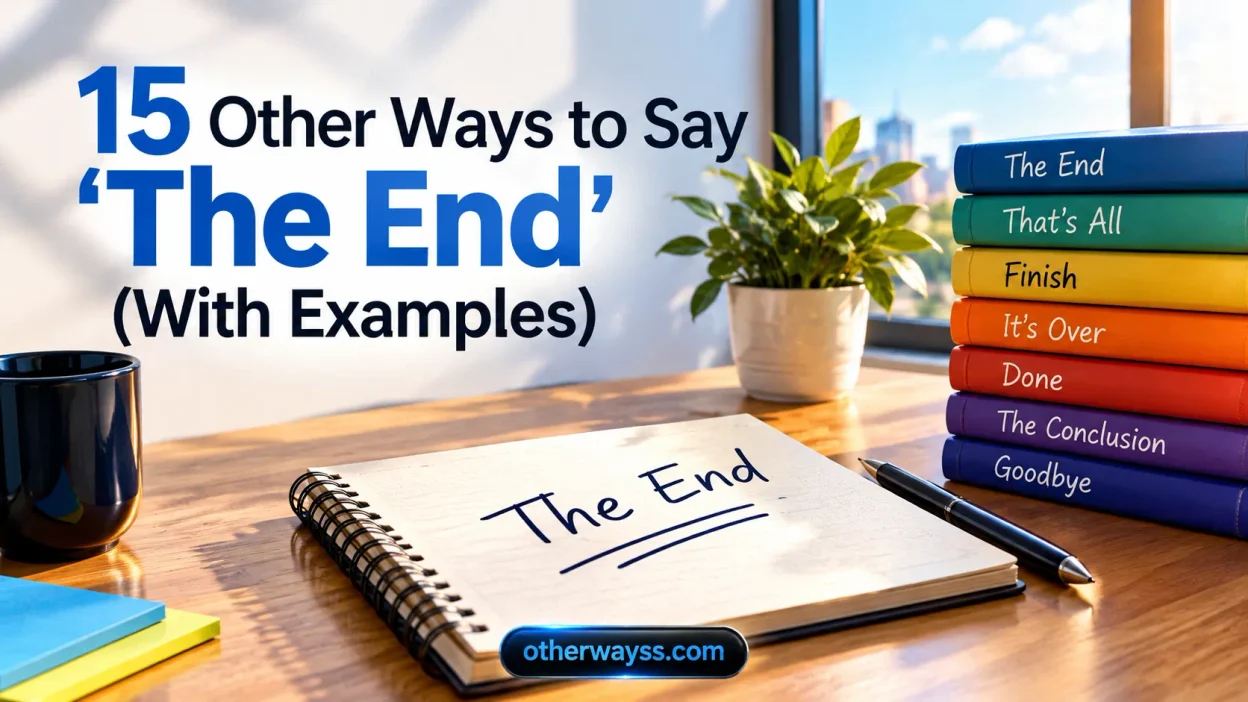
Finding other ways to say “the end” can make your writing feel fresh. The right ending adds meaning and gives your story a clear finish. It can also shape the reader’s final impression and lasting impression. So, thoughtful wording helps create a meaningful ending with the right tone.
Whether you need creative phrases, professional phrases, or emotional phrases, context matters. A closing phrase can suit a story ending, speech, report, or personal message. You can choose thoughtful alternatives that bring clarity, flow, and emotion. These options can help you conclude a story and create a memorable ending.
Synonyms for “The End”
- The Conclusion
- The Ending
- The Finish
- The Finale
- The Closing
- The Wrap-Up
- The Final Chapter
- The Last Part
- The Close
- The Completion
- The Final Stage
- The Finish Line
- The Culmination
- The End Point
- The Last Chapter of the Story
What Does “The End” Mean?
“The end” refers to the point at which something finishes or stops. It can describe the last moment of an event, the final part of a story, the completion of an activity, or the point at which a period of time comes to an end.
For example:
- “That was the end of the movie.”
- “We are finally reaching the end of the project.”
- “I knew it was the end of our conversation.”
- “At the end of the road, turn left.”
The phrase can have both a literal and an implied meaning. Literally, it may refer to a final point. Emotionally, however, “the end” can suggest closure, loss, relief, completion, or finality.
That emotional meaning matters. Saying “This is the end” can sound much more dramatic than saying “This is the conclusion.” Similarly, “the final chapter” can suggest that something meaningful is ending while leaving room for a new beginning.
The right alternative therefore depends on what you are describing and how you want the listener or reader to feel.
When to Use “The End”
“The end” is a simple, flexible expression that works in everyday conversation and many forms of writing.
It is particularly natural when you are talking about:
- The final part of a movie, book, or story
- The completion of an activity
- The final point of a journey
- The closing of a period or situation
- A situation that has reached its natural conclusion
With friends and family, “the end” is completely normal:
“I can’t believe we’re finally at the end of the trip.”
In texting, it can be short and direct:
“That’s the end of that!”
In professional communication, it is also acceptable, although a more specific expression may sound clearer:
“We are approaching the end of the project.”
For a formal email, “completion,” “conclusion,” or “final stage” may communicate the idea more precisely.
“The end” can also sound emotionally heavy when discussing relationships, major life changes, or difficult situations. In those cases, a phrase such as “the closing chapter” or “a new chapter” may sound more thoughtful.
Is It Professional or Polite to Say “The End”?
Yes. “The end” is neither inherently rude nor unprofessional. Its tone depends heavily on the surrounding words and the situation.
It can be:
- Neutral: “We are nearing the end of the meeting.”
- Casual: “That’s the end of that.”
- Dramatic: “This is the end.”
- Reflective: “We’ve reached the end of an important chapter.”
- Professional: “We are nearing the end of the process.”
The phrase can become awkward when it is unnecessarily blunt. For example, telling a colleague, “This is the end of your involvement,” may sound harsh. “This will conclude your involvement in the project” is more tactful.
In workplace communication, specificity is usually more useful than simply replacing “the end” with a fancier phrase. If you mean that a project is finished, “completion” may be better. If you mean the final section of a report, “conclusion” is more precise.
1. The Conclusion
“The conclusion” is one of the most useful and broadly appropriate alternatives to “the end.” It refers to the point where something finishes, but it often emphasizes the result, judgment, or final section rather than merely the stopping point.
This makes it especially useful in essays, reports, presentations, discussions, and formal writing. It can also describe the ending of a story, although “ending” or “finale” may sound more natural in creative contexts.
“The conclusion” generally feels more deliberate and polished than “the end.” It suggests that something has been brought to a logical close.
Scenario
Scenario: You are writing a business report and need to refer to the final section where you summarize the findings and recommendations.
Examples
- “The conclusion summarizes the project’s main findings.”
- “We reached the conclusion of the investigation after several weeks.”
- “In conclusion, the results support our original proposal.”
- “The conclusion of the meeting came after everyone had shared their views.”
- “Her conclusion was carefully based on the evidence.”
Tone
Professional, formal, clear, and thoughtful.
Explanation
“The conclusion” works when you want to emphasize logical closure rather than simply saying that something has stopped. It is particularly useful when an ending contains a summary, decision, or final judgment.
It is not always a perfect replacement. Saying “The conclusion of the road” would sound unnatural because a road normally has an end, not a conclusion. Context determines whether the phrase fits.
Best Use
Best Use: Essays, reports, presentations, formal discussions, business writing, and situations involving a final decision or summary.
2. The Ending
“The ending” is one of the most natural alternatives when you are talking about a story, movie, book, show, or narrative. Unlike “the end,” which can refer to almost anything, “the ending” usually focuses specifically on how a story finishes.
It can describe whether the final part is happy, sad, surprising, confusing, satisfying, or disappointing. It is especially common in everyday conversation because it sounds relaxed and natural.
For creative works, “the ending” often feels more conversational than “the conclusion.”
Scenario
Scenario: You have just watched a movie with a friend and want to discuss the final scene without sounding overly formal.
Examples
- “I really liked the ending of the movie.”
- “The book has a surprisingly emotional ending.”
- “Did you understand the ending?”
- “The ending changed the way I viewed the whole story.”
- “We should not spoil the ending for anyone who hasn’t watched it.”
Tone
Casual, natural, conversational, and neutral.
Explanation
“The ending” is a strong choice when the focus is on how a narrative finishes. It can carry emotional meaning without sounding dramatic.
It is more specific than “the end.” For example, “the end of the movie” can simply identify the final portion, while “the ending of the movie” often invites discussion about what happened and whether it worked.
Best Use
Best Use: Movies, books, television shows, stories, novels, conversations, reviews, and casual discussions about narratives.
3. The Finish
“The finish” refers to the point where an activity, race, task, or process is completed. It often has a more active or energetic feeling than “the end.”
The word is particularly natural when something has involved effort, progress, competition, or a clear beginning-to-finish process. You may hear it when talking about races, construction, assignments, manufacturing, or completing a difficult task.
It is less suitable for emotional endings or formal conclusions.
Scenario
Scenario: Your team has spent several months completing a demanding project, and you are discussing the final work that remains.
Examples
- “We’re almost at the finish.”
- “The finish of the race was incredibly close.”
- “I stayed focused because I could see the finish ahead.”
- “The final details brought us closer to the finish.”
- “Everyone was exhausted by the time we reached the finish.”
Tone
Direct, energetic, practical, and sometimes informal.
Explanation
“The finish” emphasizes completion after effort. It works especially well when someone has been working toward a goal.
It is not interchangeable with “the end” in every context. “The finish of the novel” is possible but less natural than “the ending of the novel.” Likewise, “the finish” can sometimes refer to a surface treatment, so context matters.
Best Use
Best Use: Races, projects, tasks, goals, physical activities, and situations where completion follows sustained effort.
4. The Finale
“The finale” is a more expressive way to refer to the final part of a performance, event, story, or series. It often suggests that the ending is important, dramatic, impressive, or designed to leave a strong impression.
The word is strongly associated with entertainment. You might use it for the final episode of a television series, the last performance of a concert, or the closing portion of a major event.
Compared with “the end,” “the finale” feels more dramatic and celebratory.
Scenario
Scenario: You are discussing the last episode of a popular television series and want to emphasize that it was the major closing event.
Examples
- “The series finale answered several important questions.”
- “The concert ended with a spectacular finale.”
- “Everyone was excited for the finale of the competition.”
- “The final dance made a perfect finale.”
- “The festival’s fireworks provided a memorable finale.”
Tone
Dramatic, expressive, celebratory, and polished.
Explanation
“The finale” is useful when the ending is not merely a stopping point but a featured final event. It can make an ending sound more significant.
However, it is not suitable for every situation. Saying “the finale of the meeting” would sound theatrical unless you are deliberately being humorous. For ordinary work situations, “closing” or “conclusion” would usually be more natural.
Best Use
Best Use: Concerts, competitions, television series, performances, festivals, ceremonies, and dramatic events.
5. The Closing
“The closing” refers to the final portion of something and is particularly useful in business, events, speeches, meetings, and formal communication.
It has a polished and organized quality. Instead of focusing on the emotional finality of “the end,” it emphasizes the process of bringing something to a close.
You might use it when discussing a closing statement, closing remarks, closing session, or the closing stage of an event.
Scenario
Scenario: You are organizing a professional conference and need to describe the final session before attendees leave.
Examples
- “The closing session begins at 4 p.m.”
- “She delivered the closing remarks.”
- “We reserved ten minutes for the closing discussion.”
- “The closing ceremony will take place on Friday.”
- “His closing statement summarized the team’s position.”
Tone
Professional, formal, organized, and respectful.
Explanation
“The closing” is particularly helpful when something is being formally brought to an end. It works well because it sounds less abrupt than simply saying “the end.”
It can also refer to a business transaction or the act of shutting something, so the surrounding context should make the intended meaning clear.
Best Use
Best Use: Meetings, conferences, ceremonies, speeches, presentations, business communication, and formal events.
Read More: 15 Other Ways to Say ‘I Look Forward to Meeting You’ (With Examples)
6. The Wrap-Up
“The wrap-up” is a friendly and informal way to describe the final part of an activity or discussion. It often suggests that people are finishing loose ends, summarizing important points, or preparing to stop.
This expression is common in workplaces, meetings, podcasts, broadcasts, projects, and casual conversations. It feels much less formal than “the conclusion.”
Use it when you want your language to sound approachable and practical.
Scenario
Scenario: Your team has finished the main part of a meeting and needs to review action items before everyone leaves.
Examples
- “Let’s use the last ten minutes for a quick wrap-up.”
- “I’ll send a short wrap-up after the meeting.”
- “The host gave a brief wrap-up of the day’s events.”
- “We’re in the wrap-up stage now.”
- “Before we finish, let’s do a quick wrap-up.”
Tone
Casual, friendly, practical, and professional in relaxed workplaces.
Explanation
“The wrap-up” focuses on the final review or finishing process rather than the final moment itself. That makes it especially useful when something still needs to be summarized or organized.
It may sound too casual for highly formal documents. In a legal report, for example, “conclusion” would usually be more appropriate.
Best Use
Best Use: Meetings, team discussions, informal workplace communication, presentations, podcasts, projects, and casual conversations.
7. The Final Chapter
“The final chapter” is a figurative expression that describes the last stage of a story, period, project, relationship, or life experience. It is especially useful when you want an ending to sound meaningful rather than merely final.
The phrase often carries an emotional or reflective quality. It can suggest that something has been important and that its ending is part of a larger journey.
Unlike “the end,” it can also imply that something new may follow.
Scenario
Scenario: You are leaving a workplace where you have spent many years and want to describe your departure in a thoughtful farewell message.
Examples
- “This feels like the final chapter of an important part of my career.”
- “We are entering the final chapter of the project.”
- “The final chapter of the novel was deeply moving.”
- “Leaving the city feels like the final chapter of an unforgettable period.”
- “As one chapter closes, another begins.”
Tone
Reflective, emotional, warm, expressive, and sometimes affectionate.
Explanation
“The final chapter” is not a literal synonym for every use of “the end.” Instead, it is a metaphorical alternative that works when something has a meaningful sequence or history.
It is especially effective when you want to soften finality. “This is the end” can sound absolute. “This is the final chapter” feels more like a transition.
Best Use
Best Use: Farewell messages, personal milestones, careers, relationships, books, major projects, and reflective writing.
8. The Last Part
“The last part” is a simple and highly accessible alternative. It refers directly to the portion that comes after everything else.
It is less polished than “the conclusion” and less expressive than “the finale,” but that is exactly why it can be useful. When clarity matters more than style, “the last part” is difficult to misunderstand.
It works particularly well in ordinary conversation when you are referring to a physical, written, or sequential section.
Scenario
Scenario: You are helping someone follow instructions and need to tell them what to do during the final portion of a process.
Examples
- “The last part of the assignment is optional.”
- “I enjoyed the last part of the book the most.”
- “We’ll discuss the last part tomorrow.”
- “The last part of the journey was surprisingly difficult.”
- “Please read the last part before our next meeting.”
Tone
Simple, neutral, direct, and conversational.
Explanation
“The last part” works because it is clear without adding unnecessary emotion. It is useful when “the end” might be ambiguous.
However, it does not always imply complete finality. “The last part of the meeting” simply identifies its final section. It does not necessarily mean the entire broader project has ended.
Best Use
Best Use: Instructions, everyday conversation, books, assignments, processes, journeys, and situations where plain language is preferred.
9. The Close
“The close” can mean the final part or moment of something. It is especially common in business, finance, journalism, events, and formal speech, although it can also appear in everyday language.
The phrase often sounds more polished than “the end.” For example, “as we approach the close of the meeting” sounds formal and deliberate.
It can also mean a specific finishing point, such as the close of business or the close of a trading day.
Scenario
Scenario: You are writing a professional message about a meeting that is nearly finished.
Examples
- “We discussed the final issue near the close of the meeting.”
- “The market rose sharply toward the close.”
- “At the close of the event, the organizers thanked everyone.”
- “We need to finalize these details before the close of business.”
- “She gave a brief speech at the close of the ceremony.”
Tone
Professional, formal, polished, and direct.
Explanation
“The close” is a useful professional alternative because it emphasizes the formal finishing point of an activity or period.
It is less natural in casual personal conversations. Telling a friend, “I’ll call you at the close of our dinner,” would sound unnecessarily formal. In everyday speech, “before dinner ends” would be more natural.
Best Use
Best Use: Business writing, finance, meetings, ceremonies, formal events, and professional communication.
10. The Completion
“The completion” focuses on the fact that something has been successfully finished. It is especially useful for projects, assignments, construction, training, contracts, applications, and other tasks with a defined objective.
Unlike “the end,” it often carries a sense of achievement or fulfillment. Something has not merely stopped; it has reached the point where the required work is done.
Scenario
Scenario: A company has finished a major project and needs to announce that the work has officially been completed.
Examples
- “The completion of the project is scheduled for December.”
- “We celebrated the completion of the new building.”
- “Your certificate will be issued after completion of the course.”
- “The team worked hard to ensure timely completion.”
- “Completion of the application requires two additional documents.”
Tone
Professional, formal, precise, and achievement-focused.
Explanation
“The completion” is often a better alternative when successfully finishing a task is the main idea. It sounds particularly natural in administrative and professional contexts.
It does not work as well for emotional or narrative endings. You would not normally describe a sad movie as having “a completion.” In that case, “ending” is much more natural.
Best Use
Best Use: Projects, contracts, courses, construction, assignments, applications, professional documents, and task-based situations.
11. The Final Stage
“The final stage” describes the last phase of a process that develops over multiple stages. It is useful when something is not quite finished yet but is approaching completion.
This distinction is important. “The end” usually identifies the final point, while “the final stage” describes the period immediately before completion.
That makes it especially useful in workplace communication, project management, development, research, and long-term plans.
Scenario
Scenario: Your team has completed most of a project but still has testing and approval to finish.
Examples
- “The project has entered its final stage.”
- “We are now in the final stage of testing.”
- “The final stage will involve reviewing the results.”
- “She is in the final stage of her training.”
- “The company is preparing for the final stage of development.”
Tone
Professional, precise, organized, and neutral.
Explanation
“The final stage” is valuable because it does not necessarily mean something has already ended. It means the process is in its last phase.
That makes it a poor replacement for “the end” when you mean something has completely stopped. However, if you want to communicate that completion is close, it can be more accurate than “the end.”
Best Use
Best Use: Projects, development, training, research, business processes, construction, and long-term plans.
12. The Finish Line
“The finish line” is a figurative expression based on racing. It describes the point where a person or group finally reaches a goal after sustained effort.
It is energetic, encouraging, and motivational. Because of that, it works particularly well when someone has been working through a difficult task and needs to recognize that completion is near.
It is not a neutral replacement for every use of “the end.”
Scenario
Scenario: A colleague has been working late to complete a demanding project, and you want to encourage them during the final stretch.
Examples
- “We’re almost at the finish line.”
- “Keep going; the finish line is in sight.”
- “After months of work, the team finally crossed the finish line.”
- “We’re close to the finish line, but a few details remain.”
- “Reaching the finish line was a huge relief.”
Tone
Encouraging, energetic, optimistic, and informal.
Explanation
“The finish line” adds the idea of effort followed by achievement. It is excellent when you want to motivate someone.
However, it can sound inappropriate in serious emotional situations. Saying “We’ve reached the finish line of our relationship” may sound cold or overly metaphorical unless that style is intentional.
Best Use
Best Use: Projects, competitions, deadlines, goals, personal challenges, motivational messages, and situations involving sustained effort.
13. The Culmination
“The culmination” is a more formal and expressive word for the point where a series of events, efforts, or developments comes together in a final result.
It is not simply another word for “the end.” It suggests that what came before contributed to the final outcome.
This makes it useful in formal writing, speeches, reviews, academic discussions, and descriptions of major achievements.
Scenario
Scenario: You are describing a large community project that took several years of planning and effort before reaching its final public event.
Examples
- “The ceremony was the culmination of years of planning.”
- “The exhibition represented the culmination of her artistic career.”
- “The final performance was the culmination of months of preparation.”
- “This achievement is the culmination of years of hard work.”
- “The announcement marked the culmination of the negotiations.”
Tone
Formal, sophisticated, reflective, and achievement-focused.
Explanation
“The culmination” works when the ending is the result of everything that happened before it. It gives an ending more depth and importance.
Because it is relatively formal, it can feel excessive in casual texting. You probably would not tell a friend, “Dinner was the culmination of our evening,” unless you were deliberately being playful.
Best Use
Best Use: Formal writing, speeches, academic work, career achievements, major projects, artistic work, and events that represent the result of long-term effort.
14. The End Point
“The end point” refers to the final position, destination, or objective of a process. It is especially useful when you are discussing progress, systems, plans, measurements, or goals.
It has a more technical and structured quality than “the end.” It is often appropriate when something has a defined starting point and destination.
The phrase can also be written as “endpoint” in technical contexts.
Scenario
Scenario: You are discussing a long-term process and need to describe the specific result that the team is working toward.
Examples
- “The end point of the process is a completed report.”
- “We need to define the end point before starting.”
- “The final test will determine whether we have reached the end point.”
- “The end point of the journey is the coastal village.”
- “Without a clear end point, the project may continue indefinitely.”
Tone
Neutral, precise, technical, and goal-oriented.
Explanation
“The end point” is most useful when you mean a defined destination or objective, not simply the final moment of an emotional or creative experience.
It provides clarity in contexts where a process needs a measurable or identifiable final point.
Best Use
Best Use: Projects, processes, planning, technical writing, journeys, goals, systems, and structured tasks.
15. The Last Chapter of the Story
“The last chapter of the story” is a more expressive and context-specific alternative. It works when you want to describe an ending as part of a larger narrative or journey.
Compared with the shorter “final chapter,” this phrase makes the metaphor clearer. It can be literal when discussing a book, but it can also be figurative when talking about a career, relationship, family period, personal experience, or historical event.
It is particularly useful when the emotional meaning of an ending matters as much as the fact that something has finished.
Scenario
Scenario: You are writing a farewell message about a long period of friendship, work, or shared experiences and want the ending to feel meaningful rather than abrupt.
Examples
- “This may be the last chapter of the story, but I’ll always value what came before.”
- “The final match felt like the last chapter of the team’s story.”
- “Retirement marked the last chapter of an extraordinary career.”
- “Their reunion felt like the last chapter of a story that had been unfinished for years.”
- “Every ending becomes part of the last chapter of the story we tell about that experience.”
Tone
Warm, reflective, emotional, expressive, and sometimes sentimental.
Explanation
This phrase works because it frames an ending as part of a larger narrative. Rather than suggesting that everything simply stops, it acknowledges the history behind the moment.
It is not ideal for straightforward business instructions or technical writing. In those situations, “completion,” “conclusion,” or “final stage” is usually clearer.
Best Use
Best Use: Farewells, personal writing, relationships, careers, stories, memoir-style writing, and meaningful transitions.
FAQs
What are the best other ways to say “the end”?
The best choice depends on the context and tone. For stories, the ending works well, while the conclusion suits formal writing.
Which alternative sounds most professional?
The conclusion, the closing, the completion, and the final stage work well in professional communication. Choose the phrase that matches the exact meaning.
What is a good alternative for the end of a story?
The ending is a natural choice for a story, book, or movie. For a more emotional or reflective tone, the final chapter can work well.
What can I say instead of the end in a work email?
Use the completion when finished work matters, or the final stage when work is nearly finished. For meetings, the closing can sound clear and professional.
Which phrase sounds warmer or more emotional than the end?
The final chapter and the last chapter of the story can create a warmer, more reflective feeling. They suggest an ending within a larger story or journey.
Conclusion
Choosing among other ways to say “the end” depends on your context, tone, and intended meaning. For stories, the ending feels natural, while the conclusion, closing, and completion suit formal or professional writing. For a more reflective emotional or personal ending, the final chapter can add warmth and meaning. Ultimately, the right alternative phrase should bring clarity, flow, and the feeling you want your readers to remember.