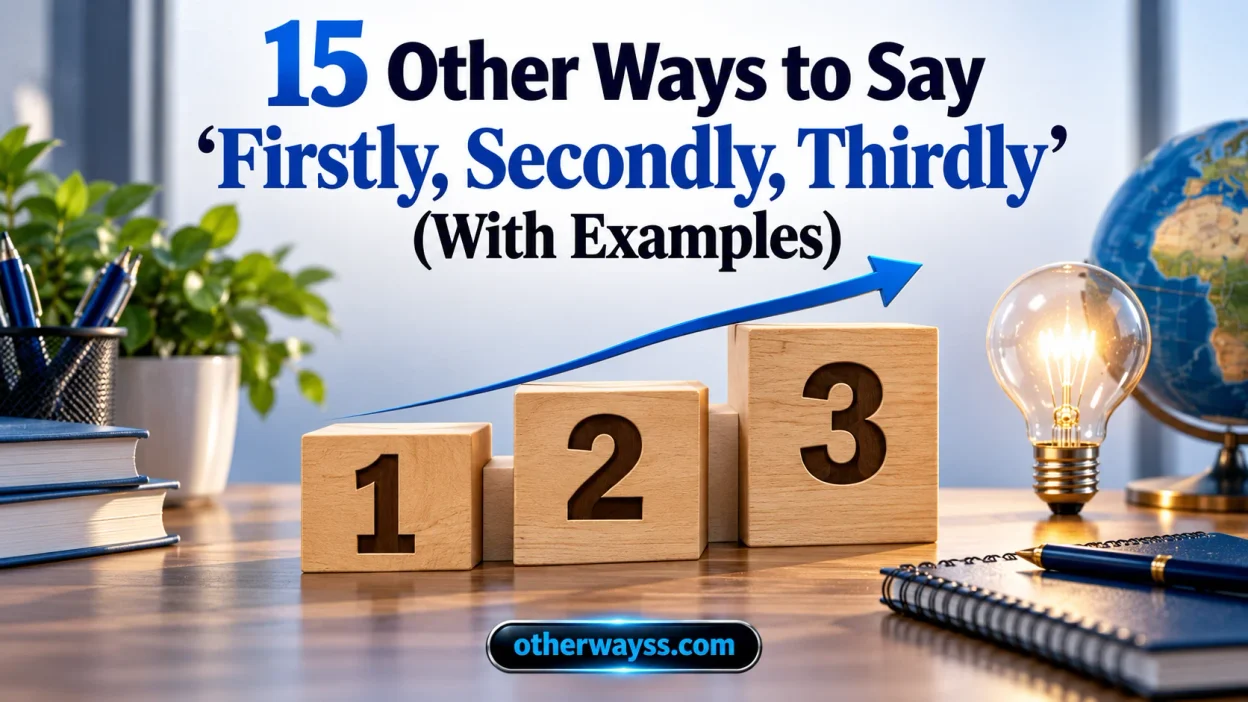
Using firstly secondly thirdly can help readers follow your order of points. However, repeating the same transition words may make writing feel predictable or stiff. Instead, varied transition phrases can create a clear sequence and improve writing flow. These sequencing words help indicate sequence while showing progression between related ideas.
Whether you write essays, reports, emails, or presentations, word choice matters. The right transition alternatives can make your structured writing smoother and easier to follow. They also support clarity, readability, and a more natural writing style. This guide explains useful alternatives to firstly secondly thirdly for different communication settings and tones.
Synonyms For “Firstly, Secondly, Thirdly”
- To begin with
- First of all
- For starters
- First
- Next
- Then
- After that
- Moving on
- Another point is
- In addition
- Furthermore
- Moreover
- Finally
- Last but not least
- To wrap up
What Does “Firstly, Secondly, Thirdly” Mean?
“Firstly, secondly, thirdly” is a set of sequencing words used to organize multiple points, reasons, arguments, instructions, or ideas.
Firstly introduces the first item. Secondly introduces the second. Thirdly introduces the third. Together, they tell the audience that the speaker or writer is presenting information in a deliberate order.
For example:
Firstly, we need to review the budget. Secondly, we should examine the timeline. Thirdly, we need to decide who will handle each task.
The expression has a logical and organized feel. It is particularly common in essays, presentations, formal discussions, reports, and structured arguments.
There is also an important distinction between the individual words. “Firstly” and “first” can both introduce an opening point, but “first” is generally more concise and conversational. Similarly, “next” usually indicates progression rather than necessarily suggesting that the second point is more important than the first.
You also do not always need a matching series. A writer can say “To begin with,” then “Next,” and finally “Finally.” In many situations, this sounds more natural than forcing every transition into the same pattern.
When to Use “Firstly, Secondly, Thirdly”
Use “firstly, secondly, thirdly” when you want to make a sequence especially obvious.
It works well when:
- You are presenting three or more arguments.
- You are explaining several reasons for a decision.
- You are organizing an essay or formal presentation.
- You want listeners to follow your points in a specific order.
- You are responding to a complicated question point by point.
- You are giving a structured explanation.
For example, in a workplace presentation, you might say:
Firstly, we need to understand the problem. Secondly, we need to identify possible solutions. Thirdly, we need to decide which solution is realistic.
In casual conversation, however, the phrase can sometimes sound more formal than necessary. With a friend, “First,” “next,” and “then” may feel more relaxed.
The same principle applies to texting. Writing “Firstly, secondly, thirdly” in a quick message is not incorrect, but it may make a simple conversation feel unusually formal.
Is It Professional or Polite to Say “Firstly, Secondly, Thirdly”?
Yes. “Firstly, secondly, thirdly” is professional and polite when the situation calls for structured communication.
It is particularly suitable for:
- Business presentations
- Academic writing
- Reports
- Formal emails
- Meetings
- Speeches
- Arguments and explanations
Its main quality is organization, not warmth. It tells the reader that your points are arranged deliberately.
However, professional does not always mean formal. In a short workplace email, “First,” “Next,” and “Finally” may be clearer and more efficient.
For example:
First, please review the attached document. Next, add your comments. Finally, send the revised version to the team.
This sounds professional without being stiff.
If you are writing to a close colleague, “Another point is” or “Moving on” may feel more conversational. If you are writing an academic paper, “Firstly” may fit better when the writing has a formal argumentative structure.
The best choice depends on how formal the setting is and how strongly you want to emphasize the sequence.
1. To Begin With
“To begin with” is one of the most natural alternatives when you want to introduce your first point. Unlike “firstly,” it sounds less mechanical and often creates a smoother transition into an explanation.
It works especially well when you are starting an argument, explaining a problem, or responding to a question with several parts. It can also introduce a fact that provides useful background before you move to the next point.
The phrase has a slightly conversational quality while remaining perfectly suitable for professional communication. It does not require you to continue with “secondly” and “thirdly.” You can naturally follow it with “next,” “another point,” or “finally.”
Scenario
Scenario: You are replying to a coworker who asked why a project has been delayed. You want to explain several contributing factors without making your email sound overly formal.
Examples
- To begin with, we need more information from the client before we can finalize the design.
- To begin with, let’s look at the most urgent issue.
- To begin with, the current schedule does not allow enough time for testing.
- To begin with, thank you for taking the time to review the proposal.
- To begin with, we should clarify what the customer actually needs.
Tone
Clear, professional, thoughtful, and moderately conversational.
Explanation
“To begin with” works as an alternative because it clearly marks the starting point of a discussion without sounding like a rigid numbered list. It is especially useful when your first point naturally opens a broader explanation.
It is not a perfect replacement for every occurrence of “firstly.” If you are explicitly numbering three arguments in a highly formal essay, “firstly” may provide stronger structural signaling. “To begin with” feels more fluid.
Best Use
Best Use: Opening an explanation, argument, email response, or professional discussion when you want the first point to feel natural rather than heavily numbered.
2. First of All
“First of all” is a familiar and flexible way to introduce the first point. It can sound more personal and conversational than “firstly,” which makes it useful in both speech and informal writing.
The phrase is especially effective when you want to emphasize that something should be considered before everything else. It can introduce a practical step, an important fact, a response to criticism, or the beginning of an explanation.
Unlike “firstly,” it does not necessarily suggest that you have a carefully numbered list. It can simply signal priority or starting order.
Scenario
Scenario: A friend asks for advice about preparing for a job interview, and you want to explain what they should focus on before discussing smaller details.
Examples
- First of all, make sure you understand what the company does.
- First of all, I want to thank everyone for their help.
- First of all, let’s make sure everyone has the correct information.
- First of all, check whether the document contains the latest figures.
- First of all, take a moment to decide what outcome you actually want.
Tone
Friendly, direct, natural, and respectful.
Explanation
“First of all” often sounds warmer than “firstly” because it is common in everyday speech. It can also emphasize priority, whereas “firstly” primarily emphasizes sequence.
That distinction matters. If you are simply listing three points, “first” may be enough. If you want to say, in effect, “before we get into anything else, consider this,” “first of all” is stronger.
It is suitable for professional settings, but in highly formal academic writing, “first” or “firstly” may sometimes sound more streamlined.
Best Use
Best Use: Conversations, emails, meetings, advice, explanations, and situations where the first point deserves special attention.
Read More: 15 Other Ways to Say ‘Please Let Me Know if This Works for You’ (With Examples)
3. For Starters
“For starters” is a more casual alternative that introduces an initial point or reason. It is particularly useful when you want your communication to sound relaxed, confident, and conversational.
Unlike “firstly,” it does not necessarily promise a carefully ordered list. Instead, it often means “as a beginning” or “as one obvious point to consider.”
Because of this, “for starters” is better suited to conversations, casual writing, informal emails, social posts, and friendly discussions than highly formal academic prose.
It can also carry a subtle sense that there are more points to come, even if you do not explicitly number them.
Scenario
Scenario: Your friend asks why you think a particular restaurant is worth trying. You want to give a few quick reasons in a relaxed conversation.
Examples
- For starters, the food is consistently fresh.
- For starters, we need to agree on the main goal.
- For starters, you could update your résumé.
- For starters, the new schedule gives everyone more flexibility.
- For starters, let’s focus on the issues we can actually control.
Tone
Casual, confident, conversational, and direct.
Explanation
“For starters” is not a strict synonym for “firstly.” It is a contextual alternative because it can perform a similar organizational function while changing the tone.
The expression is useful when you do not want your writing to sound like a formal list. It creates a more relaxed rhythm and can make an explanation feel like a natural conversation.
However, avoid it when your communication needs a strongly formal or academic tone. In those situations, “for starters” may sound too casual.
Best Use
Best Use: Casual conversations, friendly messages, informal presentations, and relaxed explanations where you want to introduce an initial point.
4. First
“First” is arguably the simplest replacement for “firstly.” It is short, clear, and widely useful. In many situations, it sounds more natural because it communicates the same sequence without adding an extra syllable.
You can use “first,” “next,” and “finally” to organize three points without repeating the more formal “firstly, secondly, thirdly” pattern.
This makes “first” especially useful in professional communication where clarity and efficiency matter. It also works in academic writing, instructions, presentations, conversation, and emails.
Scenario
Scenario: You are sending your team a short email explaining the three steps they need to complete before a meeting.
Examples
- First, review the agenda before the meeting.
- First, let’s identify the main problem.
- First, save a copy of the original file.
- First, I want to address the most urgent concern.
- First, gather all the information you need.
Tone
Clear, concise, professional, and neutral.
Explanation
“First” is a particularly strong alternative because it is simple without being informal. It does not make your writing unnecessarily elaborate.
It also gives you more flexibility in a sequence. Instead of saying “firstly, secondly, thirdly,” you can write “first, next, and finally.” This creates variation while preserving a clear progression.
For many emails, instructions, reports, and presentations, “first” is actually more efficient than “firstly.”
Best Use
Best Use: Professional emails, instructions, presentations, essays, reports, meetings, and everyday explanations.
5. Next
“Next” is one of the best alternatives to “secondly” when you are moving from one point to another. It focuses on progression rather than formal numbering.
This makes it particularly natural in spoken English and practical writing. You can use it after “first,” “to begin with,” or another opening transition.
For example:
First, check the figures. Next, review the timeline. Finally, prepare the presentation.
The sequence feels organized, but not rigid.
“Next” is also useful when explaining steps in a process. In that context, it can mean the action that should happen immediately after the current one.
Scenario
Scenario: You are explaining a simple workplace procedure to a new employee and want the instructions to sound clear rather than overly formal.
Examples
- First, open the application. Next, select the correct project.
- We reviewed the proposal. Next, we discussed the budget.
- Next, let’s consider what the customer needs.
- Add your comments to the document, and next, send it to the editor.
- Next, we need to decide who will lead the presentation.
Tone
Practical, clear, neutral, and organized.
Explanation
“Next” differs from “secondly” because it emphasizes what comes after the current point. It does not necessarily mean “the second most important idea.”
That makes it especially useful for instructions and chronological explanations.
It is also less formal than “secondly,” although it remains fully appropriate in professional writing.
Best Use
Best Use: Instructions, workplace communication, presentations, explanations, processes, and natural spoken English.
6. Then
“Then” is another useful alternative when the order of events or actions matters. It often sounds more natural than “secondly” because it connects ideas through sequence and progression.
The word is especially effective when you are explaining what happens after something else. This makes it different from a strict numbered list.
For example:
First, gather the information. Then, compare the options. Finally, make your decision.
“Then” can also make instructions easier to follow because it mirrors the way people naturally describe a process.
Scenario
Scenario: You are helping a family member understand how to complete an online form and want to explain the steps in plain English.
Examples
- First, enter your details. Then, click the confirmation button.
- Then, we can discuss what needs to change.
- Save the document, and then send it to me.
- Then, consider whether the extra cost is worthwhile.
- We can review the first draft and then decide what to revise.
Tone
Natural, practical, straightforward, and conversational.
Explanation
“Then” is best understood as a sequence marker, not a direct synonym for “secondly.” It tells the reader or listener what should happen after something else.
That distinction makes it particularly strong when you are explaining steps, events, decisions, or chronological developments.
If you are writing a formal argumentative essay where each point is deliberately numbered, “secondly” may be more explicit. If you are explaining what to do next, “then” is often more natural.
Best Use
Best Use: Instructions, processes, conversations, explanations, and chronological descriptions.
7. After That
“After that” clearly indicates that one event, action, or idea follows another. It is more specific than “secondly” because it establishes a relationship between two points.
The expression works particularly well when you are describing steps or events in time. It is less suitable when you are simply presenting unrelated arguments.
For example:
First, we will review the proposal. After that, we will discuss the budget.
The phrase makes the order easy to understand without sounding like a formal numbered list.
Scenario
Scenario: You are explaining a project schedule to a client and need to make the order of activities easy to follow.
Examples
- We will review the design, and after that, we can discuss the final price.
- After that, please send the completed form to the office.
- First, we’ll meet with the client. After that, we’ll prepare the revised proposal.
- Take a short break, and after that, we can continue the discussion.
- After that, the team will begin testing the new system.
Tone
Clear, practical, chronological, and neutral.
Explanation
“After that” is a useful contextual alternative because it describes what follows a previous event. It is not interchangeable with “secondly” when the second point is an independent argument.
Use it when the order itself matters.
For example, “Secondly, the price is too high” presents a separate argument. “After that, we discussed the price” describes a later event. Understanding that difference helps you avoid treating all sequencing expressions as exact synonyms.
Best Use
Best Use: Timelines, instructions, procedures, project plans, stories, and explanations involving a clear sequence of events.
8. Moving On
“Moving on” signals that you are leaving one topic and progressing to another. It is particularly natural in conversation, presentations, meetings, and informal professional communication.
Instead of numbering your points, it creates a sense of movement. This can make a presentation feel less mechanical.
For example:
We’ve covered the budget. Moving on, let’s discuss the project timeline.
It does not mean “secondly” in every context. Its primary purpose is to signal a topic transition, not simply a numerical position.
Scenario
Scenario: You are giving a presentation to coworkers and want to transition smoothly from the budget discussion to the implementation plan.
Examples
- Moving on, let’s look at the proposed timeline.
- Moving on, we need to consider the customer’s feedback.
- We’ve discussed the costs. Moving on, let’s examine the benefits.
- Moving on, I’d like to talk about the next phase of the project.
- Moving on, let’s consider how these changes will affect the team.
Tone
Professional, conversational, confident, and transitional.
Explanation
“Moving on” works when you want to guide your audience through different topics. It is less rigid than “secondly” because it does not explicitly number the point.
This can be an advantage during presentations. Your audience hears a natural transition rather than a sequence of formal labels.
However, “moving on” can sound abrupt if used without context. It works best when the previous point has genuinely been addressed.
Best Use
Best Use: Presentations, meetings, speeches, discussions, and professional conversations where you are transitioning between topics.
9. Another Point Is
“Another point is” is useful when you want to introduce an additional argument without suggesting that it is necessarily the second most important item.
This expression is particularly valuable in persuasive writing and discussion. It allows you to add another reason, concern, advantage, or consideration while keeping your language natural.
For example:
The proposal could reduce costs. Another point is that it would also save time.
This feels less formulaic than “firstly, secondly, thirdly.”
Scenario
Scenario: You are discussing whether your workplace should adopt a new scheduling system and want to introduce another benefit without making your argument sound like a numbered list.
Examples
- Another point is that the new system would be easier to manage.
- Another point is the amount of time we could save.
- Another point is that customers would have more flexibility.
- Another point is that we have not considered the long-term cost.
- Another point is that the proposal gives employees more control.
Tone
Thoughtful, analytical, professional, and conversational.
Explanation
“Another point is” is not a literal replacement for “secondly.” Instead, it is an alternative way to organize an argument.
Its biggest advantage is flexibility. You can introduce an additional point without implying that you have exactly three points or that they must appear in a rigid sequence.
It is particularly helpful when your argument develops naturally rather than following a predetermined numbered structure.
Best Use
Best Use: Persuasive writing, workplace discussions, essays, debates, reports, and analytical explanations.
10. In Addition
“In addition” introduces information that adds to what has already been said. It is one of the most useful alternatives when your goal is logical connection rather than strict numbering.
It can work well in professional emails, reports, academic writing, proposals, and formal explanations.
For example:
The new system will reduce administrative work. In addition, it will make reporting easier.
Notice that “in addition” does not mean “secondly.” It means there is another relevant point to add.
That makes it a better choice when the order of ideas is less important than their relationship.
Scenario
Scenario: You are writing a business proposal and want to add another benefit after explaining the main advantage.
Examples
- In addition, the new process should reduce unnecessary paperwork.
- The software is affordable. In addition, it is easy to maintain.
- In addition, employees will receive training before the change takes effect.
- The plan saves time. In addition, it reduces the risk of errors.
- In addition, we should consider how the decision will affect existing customers.
Tone
Professional, polished, logical, and neutral.
Explanation
“In addition” is especially effective when two ideas are related but not necessarily sequential.
If you are listing steps, “next” is usually better. If you are adding another argument or benefit, “in addition” may be more precise.
This distinction is important because replacing every “secondly” with “in addition” can weaken the sense of order. Choose it when the second idea adds support or information rather than simply coming next in a sequence.
Best Use
Best Use: Reports, formal emails, proposals, essays, business writing, and analytical communication.
11. Furthermore
“Furthermore” adds another supporting point and has a noticeably formal tone. It is common in academic, professional, legal, and analytical writing.
It is useful when the additional point strengthens what you have just said.
For example:
The proposal would reduce operating costs. Furthermore, it could improve customer satisfaction.
The word sounds more formal than “in addition” or “also,” so it should be used when that tone fits the context.
Scenario
Scenario: You are writing a formal report explaining why a proposed policy could benefit an organization in several ways.
Examples
- The system is more efficient. Furthermore, it is easier to maintain.
- Furthermore, the proposal addresses several concerns raised by employees.
- The approach reduces costs. Furthermore, it improves consistency.
- Furthermore, the available evidence supports the proposed change.
- The policy would simplify the process. Furthermore, it would make responsibilities clearer.
Tone
Formal, professional, analytical, and authoritative.
Explanation
“Furthermore” is not a direct synonym for “secondly.” It is a formal additive transition.
Its value lies in showing that the next point provides additional support. It often creates a stronger argumentative relationship than a simple sequence marker.
Because of its formal character, it can sound unnatural in a text message or casual conversation. In those settings, “also,” “another point,” or “plus” may feel more appropriate.
Best Use
Best Use: Academic essays, formal reports, professional documents, policy writing, and structured arguments.
12. Moreover
“Moreover” is another formal transition used to introduce additional information, especially when the new point makes an argument stronger.
It can sometimes feel more emphatic than “in addition.” The writer is not merely adding another fact but often signaling that the new information is particularly relevant or persuasive.
For example:
The location is convenient. Moreover, the building offers flexible office space.
The expression is polished and useful in formal writing, but it is not normally the best choice for casual texting.
Scenario
Scenario: You are writing a formal recommendation and want to add a particularly strong reason supporting your conclusion.
Examples
- The proposal is affordable. Moreover, it can be implemented quickly.
- Moreover, the changes would benefit both customers and employees.
- The plan is practical. Moreover, it requires very little additional training.
- Moreover, the evidence suggests that the current approach is no longer effective.
- The location is accessible. Moreover, it has enough space for future expansion.
Tone
Formal, polished, persuasive, and professional.
Explanation
“Moreover” works as a contextual alternative because it introduces an additional argument with emphasis. It is better when you want the next point to strengthen the previous one rather than merely follow it chronologically.
Do not use it simply because you need another word for “secondly.” If your points are instructions or events, “next” or “then” will usually be clearer.
Best Use
Best Use: Formal essays, reports, proposals, persuasive writing, and professional arguments where an additional point deserves emphasis.
13. Finally
“Finally” is one of the most useful alternatives in this entire group because it clearly introduces the last point.
Instead of using “thirdly” simply because it is the third item, you can use “finally” when the point is the conclusion of the sequence.
For example:
First, we’ll review the budget. Next, we’ll discuss the timeline. Finally, we’ll decide on the next steps.
This sequence sounds natural in both spoken and written English.
“Finally” also has a broader meaning. It can introduce the last step, the final argument, or the concluding thought.
Scenario
Scenario: You are closing a workplace presentation after discussing two major issues and want to clearly signal that one final point remains.
Examples
- Finally, we need to decide who will oversee the project.
- First, review the data. Next, compare the results. Finally, write your conclusion.
- Finally, I’d like to thank everyone who contributed to the project.
- Finally, consider whether this solution will work in the long term.
- We have discussed the costs and benefits. Finally, let’s look at the implementation plan.
Tone
Clear, professional, organized, and conclusive.
Explanation
“Finally” is more precise than “thirdly” when you are introducing the last item. It tells the audience that the sequence is coming to an end.
It also avoids the need to use “secondly” if “next” already does the job.
A natural sequence might therefore be:
First, identify the problem. Next, compare the options. Finally, choose a solution.
This often feels smoother than:
Firstly, identify the problem. Secondly, compare the options. Thirdly, choose a solution.
Best Use
Best Use: The final point in an essay, presentation, explanation, meeting, list, or set of instructions.
14. Last but Not Least
“Last but not least” introduces the final item while emphasizing that it should not be considered less important simply because it appears last.
This expression is warmer and more expressive than “thirdly” or “finally.” It is especially common when introducing people, thanking contributors, presenting several choices, or highlighting a final item that deserves recognition.
It can sound too casual or theatrical for some formal reports, so context matters.
Scenario
Scenario: You are giving a presentation and introducing several members of a project team. You want to make sure the final person does not feel overlooked.
Examples
- Last but not least, I’d like to thank our design team.
- Last but not least, remember to save your work before closing the application.
- Last but not least, we need to consider the needs of existing customers.
- Last but not least, thank you to everyone who helped organize the event.
- Last but not least, let’s recognize the people working behind the scenes.
Tone
Warm, appreciative, friendly, expressive, and sometimes informal.
Explanation
This phrase is not simply another way to say “thirdly.” Its distinctive meaning is that the final point is still important.
That makes it especially effective when the final item involves people, recognition, appreciation, or a point that could otherwise seem secondary.
It is less suitable for highly technical writing where a straightforward “finally” would be clearer.
Best Use
Best Use: Speeches, presentations, appreciation messages, introductions, team communication, and friendly professional settings.
15. To Wrap Up
“To wrap up” is a conversational way to signal that you are bringing a discussion, explanation, or presentation toward its conclusion.
It is not a direct substitute for “thirdly.” Instead, it works when the final point also serves as a closing thought or summary.
For example:
We have reviewed the costs and discussed the timeline. To wrap up, let’s agree on the next steps.
The phrase feels natural in meetings, presentations, emails, conversations, and informal professional communication.
It is generally less formal than “in conclusion,” although it can still be perfectly appropriate in many workplace settings.
Scenario
Scenario: You have finished discussing several issues during a team meeting and want to close the discussion by focusing everyone on what happens next.
Examples
- To wrap up, let’s agree on the three actions we need to take.
- To wrap up, the proposal offers a practical solution to the problem.
- To wrap up, I’d like to summarize the main decisions from today’s meeting.
- To wrap up, please send me your final comments by Friday.
- To wrap up, we have a clear plan and can begin the next phase.
Tone
Conversational, professional, friendly, and conclusive.
Explanation
“To wrap up” is best viewed as a closing transition, not a numbered sequence marker. It works when your final point also helps finish the conversation or summarize what has been discussed.
It is a particularly good choice when “finally” feels too formal but “thirdly” feels too mechanical.
If you are writing an academic essay, a more formal closing transition may be preferable. In a meeting or presentation, however, “to wrap up” can sound natural and engaging.
Best Use
Best Use: Meetings, presentations, workplace conversations, informal emails, summaries, and discussions that are coming to an end.
FAQs
What is the best alternative to “firstly, secondly, thirdly”?
First, next, and finally is a clear and flexible transition sequence for most writing. However, the best choice depends on your writing context, tone, and purpose.
Which alternative sounds most professional?
Furthermore, moreover, in addition, first, next, and finally can all suit professional writing. Choose based on whether you want to show sequence or add another supporting point.
What should I use instead of “firstly, secondly, thirdly” in texting?
For texting, first, then, next, and for starters usually sound more natural. These transition alternatives keep messages clear without making casual communication feel too formal.
Can I mix different transition words in the same sequence?
Yes. You can combine to begin with, next, and finally to create smoother writing flow. Mixing transitions can also reduce repetition and make your writing style feel more natural.
Is “finally” a good replacement for “thirdly”?
Yes, when you are introducing the final point. Finally clearly signals the end of a sequence and often sounds smoother than repeating thirdly in essays, reports, presentations, and emails.
Conclusion
Choosing the right alternatives to firstly secondly thirdly depends on your writing context, purpose, and tone. Use first, next, and finally for clear, natural sequence expressions, while in addition, furthermore, and moreover suit added ideas. Ultimately, varied transition words can improve clarity, flow, and readability without making your writing feel repetitive or stiff.